The short version
- Aperture is the lens opening, written as an f-number (focal length ÷ opening diameter).
- Smaller f-number = bigger opening = more light and shallower depth of field.
- Full stops: f/1.4, 2, 2.8, 4, 5.6, 8, 11, 16, 22.
- Background blur also grows with longer lenses, closer subjects and distant backgrounds.
- Most lenses are sharpest around f/5.6 to f/8.
Last updated · Exposure Triangle Simulator editorial team · How we test
What the f-number means
The f-number is the lens focal length divided by the diameter of the opening. On a 50mm lens, f/2 is a 25mm opening and f/8 is a 6.25mm opening. That is why smaller numbers mean bigger holes.
The full-stop sequence below each lets in half the light of the one before. The numbers go up by about 1.4 each time, because halving the area of a circle shrinks its diameter by the square root of 2.
How aperture controls depth of field
Depth of field is how much of the scene, front to back, looks sharp. Only one distance is ever in perfect focus. Everything nearer or farther blurs a little, and the wider the aperture, the faster it blurs.
The simulator is set to an 85mm lens at f/1.4 focused on the person. Tap the arches to move focus, then load the landscape setup and see the plants, the person and the arches all sharp at f/16.
| Aperture | Depth of field | Good for |
|---|---|---|
| f/1.2 – f/2 | Very shallow | Portraits, low light, isolating one subject |
| f/2.8 – f/4 | Shallow | Couples, small groups, events, sports |
| f/5.6 – f/8 | Moderate | Street, travel, groups, general use |
| f/11 – f/16 | Deep | Landscapes, architecture, sunny days |
| f/22+ | Deepest, but softer | Only when you need maximum depth |
Past about f/11, diffraction slowly softens the whole image. The sweet spot for sharpness on most lenses is f/5.6 to f/8.
How to get a blurry background
Aperture is only one of four things that control background blur:
- Open the aperture to the smallest f-number your lens has.
- Use a longer lens. If you step back to keep the person the same size, an 85mm or 135mm lens magnifies the background and its blur.
- Get closer to your subject.
- Put distance between the subject and the background.
Try the same f/2.8 on a 24mm and a 135mm lens. The person stays the same size. The arches grow and melt away.
Bokeh
Out-of-focus points of light turn into discs called bokeh. At the widest apertures they are round. Stop down past about f/2 and they take the shape of the aperture blades: the simulator's lens has seven blades, so the discs become heptagons.
How to change aperture on your camera
- Choose A (Sony, Nikon, Fujifilm) or Av (Canon) to set aperture while the camera handles shutter speed. Or use M.
- Turn the command dial. Some lenses, especially Fujifilm, have an aperture ring on the lens itself.
- Your lens's widest aperture is printed on it: a "50mm 1:1.8" lens opens to f/1.8. Zoom lenses may list a range like 3.5–5.6, which means the widest aperture gets smaller as you zoom in.
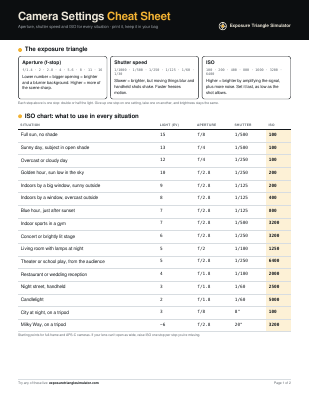
Get the printable camera settings cheat sheet
Two pages to keep in your camera bag: the full ISO chart, settings for 10 common shots, handheld shutter speeds by lens, ND filter times and the five rules worth memorizing.
You’re in.
Your cheat sheet is ready. Print it on letter or A4 paper.
Download the PDFPreview only: nothing was saved, and downloads are blocked in this preview. On the live site, signups appear in your Netlify dashboard under Forms.
Frequently asked questions
Is a lower f-stop better?
Not better, just different. A low f-number gathers more light and blurs the background. A high f-number keeps more of the scene sharp. Pick based on what you want in focus.
What aperture should I use for portraits?
f/1.8 to f/2.8 for a single person, f/4 to f/5.6 for small groups so everyone’s face is sharp.
What aperture should I use for landscapes?
f/8 to f/11 on full frame, f/5.6 to f/8 on smaller sensors, focused about a third of the way into the scene.
Why is a smaller f-number a bigger aperture?
Because the f-number is a ratio: focal length divided by opening diameter. A bigger opening divides into the focal length fewer times.
What is a fast lens?
A lens with a wide maximum aperture, such as f/1.4 or f/1.8. It gathers more light, allowing faster shutter speeds.