The short version
- Portraits: f/1.8–f/2.8, 1/250 s or faster, lowest workable ISO.
- Landscapes: f/8–f/11, ISO 100, tripod if below 1/focal length.
- Sports: 1/1000 s or faster, wide aperture, Auto ISO.
- Sunny day: f/16 at 1/125 s, ISO 100.
Last updated · Exposure Triangle Simulator editorial team · How we test
Settings by situation
| Situation | Aperture | Shutter | ISO | |
|---|---|---|---|---|
| Sunny day (Sunny 16) | f/16 | 1/125 | 100 | |
| Portrait, soft background | f/2 | 1/250 | 100 | |
| Portrait, extreme blur | f/1.4 | 1/500 | 100 | |
| Landscape, all sharp | f/11 | 1/250 | 100 | |
| Sports and traffic | f/2.8 | 1/1000 | 200 | |
| Motion blur, tripod | f/8 | 1/8 | 400 | |
| Blue hour, tripod | f/8 | 1" | 100 | |
| Night street, handheld | f/1.8 | 1/60 | 2500 | |
| Light trails, tripod | f/8 | 8" | 100 | |
| Indoor, window light | f/2.8 | 1/125 | 800 | |
| Stars, tripod | f/2.8 | 15"–20" | 3200–6400 |
Five rules worth memorizing
- Sunny 16: in bright sun, f/16 at 1/ISO. More
- 1/focal length: the slowest safe handheld shutter speed. More
- Choose what matters first: motion means shutter first, depth means aperture first, ISO last.
- Protect the highlights: blown whites can't be recovered, dark shadows usually can.
- Sharp beats clean: raise ISO before you accept a blurry photo. More
Minimum handheld shutter speed by lens
| Focal length | Full frame | APS-C (×1.5) | With 4 stops of stabilization |
|---|---|---|---|
| 24mm | 1/25 | 1/40 | 1/2 |
| 35mm | 1/40 | 1/50 | 1/3 |
| 50mm | 1/50 | 1/80 | 1/4 |
| 85mm | 1/100 | 1/125 | 1/6 |
| 135mm | 1/160 | 1/200 | 1/10 |
| 200mm | 1/200 | 1/320 | 1/13 |
Stabilization helps with your hands, not with moving subjects.
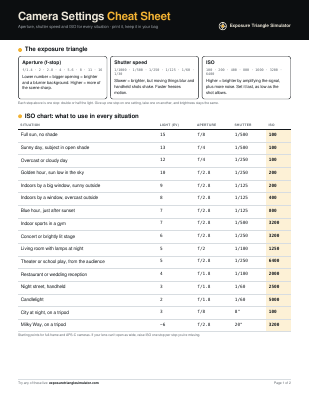
Get the printable camera settings cheat sheet
Two pages to keep in your camera bag: the full ISO chart, settings for 10 common shots, handheld shutter speeds by lens, ND filter times and the five rules worth memorizing.
You’re in.
Your cheat sheet is ready. Print it on letter or A4 paper.
Download the PDFPreview only: nothing was saved, and downloads are blocked in this preview. On the live site, signups appear in your Netlify dashboard under Forms.
Frequently asked questions
What are the best camera settings for beginners?
Aperture Priority at f/4, Auto ISO with a maximum of 6400 and a minimum shutter speed of 1/250. It handles most situations while you learn.
What are good settings for portraits?
f/1.8 to f/2.8, 1/250 or faster, the lowest ISO that gives a correct exposure, and focus on the nearest eye.
What are good settings for landscapes?
f/8 to f/11, ISO 100, and whatever shutter speed balances the exposure, on a tripod if it drops below 1/focal length.
What are good settings for sports?
Shutter Priority or Manual at 1/1000 or faster, the widest aperture your lens has, and Auto ISO.