The short version
- Depth of field gets shallower with a wider aperture, a longer focal length and a closer focus distance.
- Roughly one third of the sharp zone is in front of the focus point and two thirds behind, except at close range.
- Focusing at the hyperfocal distance keeps everything from half that distance to infinity sharp.
- Standard circle of confusion: 0.030 mm full frame, 0.020 mm APS-C, 0.015 mm Micro Four Thirds.
Last updated · Exposure Triangle Simulator editorial team · How we test
What is depth of field?
A lens focuses perfectly at only one distance. Objects nearer or farther are slightly blurred, but if the blur is small enough the eye still reads them as sharp. Depth of field is the range of distances where that blur stays below the threshold.
That threshold is the circle of confusion: the largest blur spot that still looks like a point in a normal print viewed at a normal distance. The usual convention is the sensor diagonal divided by 1500, which gives 0.030 mm on full frame.
Want to see it rather than calculate it? The aperture lesson opens the camera simulator at f/1.4, where you can watch the background blur change.
Depth of field formulas
This calculator uses the standard thin-lens equations, with focal length f, f-number N, circle of confusion c and focus distance s, all in millimeters:
| Value | Formula |
|---|---|
| Hyperfocal distance H | f² ÷ (N × c) + f |
| Near limit | s × (H − f) ÷ (H + s − 2f) |
| Far limit | s × (H − f) ÷ (H − s), or infinity when s ≥ H |
| Total depth of field | Far limit − near limit |
Worked example
A 50mm lens at f/2.8 on full frame: H = 50² ÷ (2.8 × 0.03) + 50 = 29,812 mm, about 29.8 m. Focused at 3 m, the near limit is 2.73 m and the far limit is 3.33 m, for about 0.6 m of depth of field.
How to use hyperfocal distance
- Pick your aperture, usually f/8 to f/11 for landscapes.
- Read the hyperfocal distance from the calculator.
- Focus at that distance. Use manual focus or focus on something about that far away.
- Everything from half the hyperfocal distance to infinity will be acceptably sharp.
| Lens (full frame) | f/8 | f/11 | f/16 |
|---|---|---|---|
| 16mm | 1.1 m | 0.8 m | 0.55 m |
| 24mm | 2.4 m | 1.8 m | 1.2 m |
| 35mm | 5.1 m | 3.7 m | 2.6 m |
| 50mm | 10.5 m | 7.6 m | 5.3 m |
What changes depth of field
| Change | Depth of field |
|---|---|
| Wider aperture (f/8 → f/2) | Shallower |
| Longer focal length, same distance | Shallower |
| Closer focus distance | Much shallower |
| Smaller sensor, same framing | Deeper |
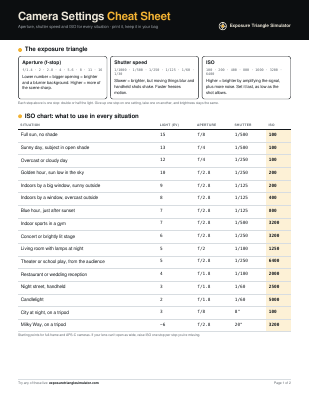
Get the printable camera settings cheat sheet
Two pages to keep in your camera bag: the full ISO chart, settings for 10 common shots, handheld shutter speeds by lens, ND filter times and the five rules worth memorizing.
You’re in.
Your cheat sheet is ready. Print it on letter or A4 paper.
Download the PDFPreview only: nothing was saved, and downloads are blocked in this preview. On the live site, signups appear in your Netlify dashboard under Forms.
Frequently asked questions
How do you calculate depth of field?
Find the hyperfocal distance H = f² ÷ (N × c) + f. Then the near limit is s(H − f) ÷ (H + s − 2f) and the far limit is s(H − f) ÷ (H − s), where s is the focus distance.
What circle of confusion should I use?
0.030 mm for full frame, 0.020 mm for most APS-C, 0.019 mm for Canon APS-C and 0.015 mm for Micro Four Thirds. Use a smaller value if you print very large or zoom in to 100%.
Does a smaller sensor give more depth of field?
At the same framing and f-number, yes. A smaller sensor needs a shorter lens for the same view, and that increases depth of field.
Is depth of field split evenly in front and behind?
No. At normal distances about one third is in front of the focus point and two thirds behind. Up close, in macro, it becomes nearly 50/50.