The short version
- 500 rule: max shutter = 500 ÷ (focal length × crop factor).
- NPF rule (simplified): max shutter = (35 × f-number + 30 × pixel pitch in µm) ÷ focal length.
- On sensors above about 24 MP, the 500 rule allows slight trailing; use NPF or the 300 rule.
- Typical Milky Way settings: 14–24mm, f/1.8–f/2.8, ISO 3200–6400, within the NPF time.
Last updated · Exposure Triangle Simulator editorial team · How we test
What is the 500 rule?
The 500 rule divides 500 by the full-frame-equivalent focal length to get the longest exposure in seconds before stars visibly trail. With a 20mm lens on full frame, 500 ÷ 20 = 25 seconds. On an APS-C camera with a 1.5× crop, 500 ÷ 30 ≈ 16 seconds.
It was devised for film and small prints. On today's high-resolution sensors, viewed at 100%, stars at the 500-rule limit look slightly elongated. Many astrophotographers use 300 instead of 500, or the NPF rule.
The NPF rule
The NPF rule, developed by Frédéric Michaud for the Société Astronomique du Havre, accounts for the f-number (N), the pixel pitch (P) and the focal length (F). The simplified version used here is:
| Rule | Formula |
|---|---|
| NPF (simplified) | (35 × N + 30 × p) ÷ f |
| 500 rule | 500 ÷ (f × crop) |
| 300 rule | 300 ÷ (f × crop) |
Pixel pitch is calculated from the sensor width and megapixel count, assuming a 3:2 sensor (4:3 for Micro Four Thirds and medium format).
Milky Way camera settings
- Use the widest, fastest lens you have: 14–24mm at f/1.4–f/2.8.
- Set the shutter to the NPF time from the calculator.
- Raise ISO to 3200–6400 until the histogram sits about a third from the left.
- Focus manually on a bright star in live view at maximum magnification.
- Use a sturdy tripod, the 2-second timer, and shoot from a dark-sky location around new moon.
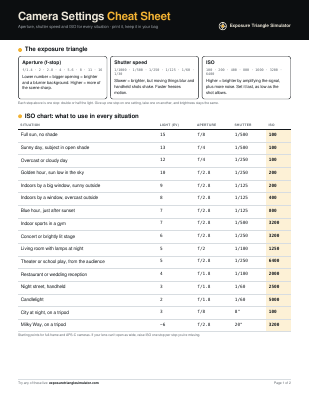
Get the printable camera settings cheat sheet
Two pages to keep in your camera bag: the full ISO chart, settings for 10 common shots, handheld shutter speeds by lens, ND filter times and the five rules worth memorizing.
You’re in.
Your cheat sheet is ready. Print it on letter or A4 paper.
Download the PDFPreview only: nothing was saved, and downloads are blocked in this preview. On the live site, signups appear in your Netlify dashboard under Forms.
Frequently asked questions
What is the 500 rule in photography?
A guideline for the longest shutter speed before stars trail: 500 divided by the focal length times the crop factor.
Is the 500 rule accurate?
It is a good starting point, but on high-resolution sensors it allows visible trailing at 100% view. The NPF rule is more accurate.
What shutter speed for stars at 14mm?
On full frame, about 35 seconds by the 500 rule, and roughly 15–20 seconds by the NPF rule on a typical 24–45 MP camera at f/2.8.
How do I photograph star trails instead?
Use a tripod and either one very long exposure in Bulb mode or many 20–30 second exposures stacked in software.