The short version
- EV = log₂(N² ÷ t) at ISO 100; one EV is one stop.
- A higher EV means brighter light: bright sun is about EV 15, a lit street at night about EV 5–8.
- Every combination with the same EV gives the same brightness.
- Raising ISO by one stop lets you use one EV less light.
Last updated · Exposure Triangle Simulator editorial team · How we test
What is exposure value?
Exposure value (EV) collapses aperture and shutter speed into one number. EV 0 is f/1 at 1 second. Each step up halves the light the settings let in, so EV 1 could be f/1.4 at 1 second or f/1 at 1/2 second.
Photographers also use EV to describe how bright a scene is: the EV that correctly exposes it at ISO 100. That is what makes the number useful. If you know the light is EV 12, any setting that adds up to EV 12 will work.
The exposure triangle lesson shows the same math live: its light budget panel adds up EV as you turn the dials.
EV formula
| Formula | Meaning |
|---|---|
| EV = log₂(N² ÷ t) | N is the f-number, t is the shutter time in seconds |
| EV₁₀₀ = log₂(N² ÷ t) − log₂(ISO ÷ 100) | Adjusts the value to ISO 100 so it describes the light |
Example: f/16 at 1/125 s and ISO 100 gives log₂(256 × 125) = log₂(32,000) ≈ 14.97, or EV 15. That is the Sunny 16 rule.
Exposure value chart
Approximate EV at ISO 100 for common lighting. Real scenes vary by a stop or more, so use these as starting points and check the meter.
| EV | Lighting |
|---|---|
| 16 | Bright sun on snow or sand |
| 15 | Bright sun, hard shadows |
| 14 | Hazy sun |
| 13 | Bright overcast |
| 12 | Heavy overcast |
| 11 | Open shade, sunset |
| 10 | Just after sunset |
| 8 – 9 | Brightly lit streets and signs at night |
| 5 – 7 | Indoors, home and office lighting |
| 3 – 4 | Floodlit buildings, dim night streets |
| −2 | Landscape under a full moon |
| −6 | Starlit sky |
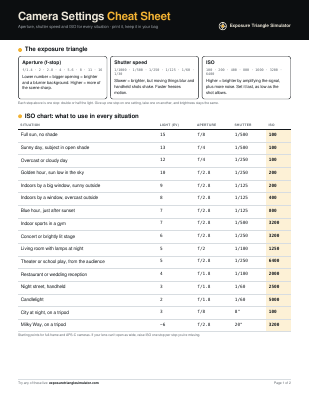
Get the printable camera settings cheat sheet
Two pages to keep in your camera bag: the full ISO chart, settings for 10 common shots, handheld shutter speeds by lens, ND filter times and the five rules worth memorizing.
You’re in.
Your cheat sheet is ready. Print it on letter or A4 paper.
Download the PDFPreview only: nothing was saved, and downloads are blocked in this preview. On the live site, signups appear in your Netlify dashboard under Forms.
Frequently asked questions
What is EV in photography?
Exposure value: a single number for a combination of aperture and shutter speed, or for how bright a scene is. One EV is one stop.
What EV is a sunny day?
About EV 15 at ISO 100, which is f/16 at 1/125 s. Snow or sand in bright sun is about EV 16.
Is a higher EV brighter or darker?
A higher EV means brighter light in the scene, and settings that let in less light to match it.
What is the difference between EV and exposure compensation?
EV measures light. Exposure compensation, also written in EV, tells the camera to make the photo brighter (+1 EV) or darker (−1 EV) than its meter suggests.