The short version
- Each stop of ND doubles the shutter time: new time = old time × 2^stops.
- ND8 = 3 stops, ND64 = 6 stops, ND1000 = 10 stops, ND32000 = 15 stops.
- Optical density 0.3 equals one stop: a 0.9 filter is 3 stops, a 3.0 filter is 10.
- Past 30 seconds, switch to Bulb mode and time the exposure.
Last updated · Exposure Triangle Simulator editorial team · How we test
What an ND filter does
A neutral density filter is dark glass that reduces all colors of light equally. It lets you use a slow shutter speed or a wide aperture in bright light without overexposing. Typical uses: smooth waterfalls and seas, streaking clouds, people vanishing from busy squares, and shooting video at f/1.8 in daylight.
To see what a slow shutter does to motion, the shutter speed lesson opens the camera simulator with a moving car.
ND filter chart
| Filter name | Optical density | Stops | Light passed | 1/125 s becomes |
|---|---|---|---|---|
| ND2 | 0.3 | 1 | 50% | 1/60 s |
| ND4 | 0.6 | 2 | 25% | 1/30 s |
| ND8 | 0.9 | 3 | 12.5% | 1/15 s |
| ND16 | 1.2 | 4 | 6.25% | 1/8 s |
| ND64 | 1.8 | 6 | 1.6% | 1/2 s |
| ND1000 | 3.0 | 10 | 0.1% | 8 s |
| ND32000 | 4.5 | 15 | 0.003% | 4 min 22 s |
Filter names use the light reduction factor (ND8 cuts light to 1/8). Some brands label by stops ("10-stop") or density ("0.9"). They describe the same thing.
How to shoot a long exposure with an ND filter
- Put the camera on a tripod and compose.
- Without the filter, set ISO 100 and your aperture (f/8–f/11), and find the correct shutter speed.
- Focus, then switch the lens to manual focus. Autofocus struggles through a dark filter.
- Screw on the filter and set the new shutter speed from the calculator.
- Cover the viewfinder (on DSLRs) so light doesn't leak in, and use a remote or the 2-second timer.
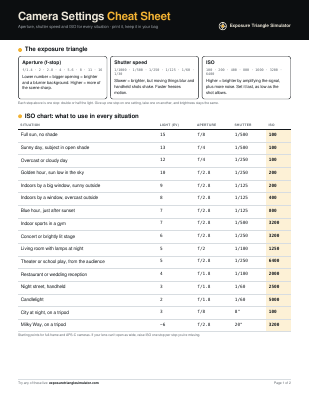
Get the printable camera settings cheat sheet
Two pages to keep in your camera bag: the full ISO chart, settings for 10 common shots, handheld shutter speeds by lens, ND filter times and the five rules worth memorizing.
You’re in.
Your cheat sheet is ready. Print it on letter or A4 paper.
Download the PDFPreview only: nothing was saved, and downloads are blocked in this preview. On the live site, signups appear in your Netlify dashboard under Forms.
Frequently asked questions
What does ND1000 mean?
The filter reduces light by a factor of 1,000, which is 10 stops. A 1/125 s exposure becomes 8 seconds.
How do you calculate ND filter exposure time?
Multiply the shutter time without the filter by 2 raised to the number of stops. 1/60 s with a 6-stop filter is 1/60 × 64 ≈ 1 second.
What ND filter should I buy first?
A 6-stop (ND64) for flowing water and a 10-stop (ND1000) for long daylight exposures cover most needs. A variable ND is popular for video.
Do ND filters change colors?
Good ones barely do. Cheaper strong filters can add a color cast, often magenta or blue, which you can correct with white balance.