The short version
- Exposure is set by aperture, shutter speed and ISO together.
- All three are measured in stops, so one can be traded for another at the same brightness.
- f/4 at 1/2000, f/8 at 1/500 and f/16 at 1/125 (ISO 100) are equivalent exposures.
- Sunny 16: in bright sun, f/16 at 1/ISO.
Last updated · Exposure Triangle Simulator editorial team · How we test
The three sides of the triangle
| Setting | What it controls | Brighter by | Side effect |
|---|---|---|---|
| Aperture | Size of the opening in the lens | Lower f-number (f/8 → f/4) | Shallower depth of field |
| Shutter speed | How long the sensor collects light | Slower shutter (1/500 → 1/125) | Motion blur and camera shake |
| ISO | How much the signal is amplified | Higher ISO (200 → 800) | More noise, less dynamic range |
Stops: the unit that ties it together
A stop is a doubling or halving of light. All three settings are measured in stops, which is what makes the triangle work:
| One stop brighter | |||
|---|---|---|---|
| Aperture | f/5.6 → f/4 | Shutter | 1/250 → 1/125 |
| ISO | 200 → 400 | Result | Twice the light |
Because the unit is shared, you can trade. These three exposures are exactly as bright as each other. Only the depth of field and motion change:
The light budget panel under the viewfinder does this math live. Each setting is worth a number of EV (exposure value). When your settings add up to the EV of the scene, the exposure is balanced.
The Sunny 16 rule
In bright, direct sun, set the aperture to f/16 and the shutter speed to 1 over your ISO. At ISO 100 that is f/16 at 1/125 (the closest camera setting to 1/100). The simulator is loaded with exactly that. Any equivalent works too: f/8 at 1/500, or f/4 at 1/2000.
| Light | Aperture at 1/ISO |
|---|---|
| Bright sun, sharp shadows | f/16 |
| Slight overcast, soft shadows | f/11 |
| Overcast, barely any shadows | f/8 |
| Heavy overcast | f/5.6 |
| Open shade, sunset | f/4 |
Overexposed vs underexposed
An overexposed photo has too much light: bright areas turn pure white and the detail in them is gone for good. An underexposed photo has too little: shadows go black and brightening them later brings up noise.
Watch three things to judge exposure: the meter (centered is balanced), the histogram (no tall spike against either edge), and the clipping warning (red stripes over lost highlights). Most photographers expose so the highlights are just short of clipping.
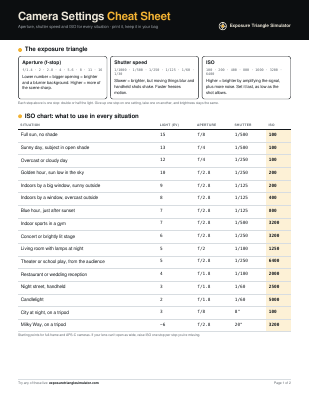
Get the printable camera settings cheat sheet
Two pages to keep in your camera bag: the full ISO chart, settings for 10 common shots, handheld shutter speeds by lens, ND filter times and the five rules worth memorizing.
You’re in.
Your cheat sheet is ready. Print it on letter or A4 paper.
Download the PDFPreview only: nothing was saved, and downloads are blocked in this preview. On the live site, signups appear in your Netlify dashboard under Forms.
Frequently asked questions
What is the exposure triangle in simple terms?
Three settings control how bright a photo is: aperture (how wide the lens opens), shutter speed (how long it stays open) and ISO (how much the signal is boosted). Balance them to get the right brightness with the look you want.
Which setting should I choose first?
Choose the one that matters most for the photo. Moving subject: shutter speed. Background blur or deep focus: aperture. Then set the other, and use ISO last to balance the exposure.
What is a stop in photography?
A doubling or halving of light. Cameras usually adjust in thirds of a stop.
What is EV in photography?
Exposure value, a single number for a combination of aperture and shutter speed. Bright sun is about EV 15 at ISO 100, a lit street at night about EV 5 to 8.